YES, SPANDEX IS RECYCLABLE
In M&T2, The LYCRA Company’s Arnaud Ruffin explains how we’re partnering to pioneer the future of textile circularity
四月 07, 2026
There’s a pervasive belief in the textile industry that spandex is the obstacle to true circularity. Spandex is not recyclable, the thinking goes. It can’t be separated from companion yarns. It’s an unsolvable, immoveable problem.
But while spandex has posed challenges to textile recycling in the past, the future looks bright: Early pilot projects by The LYCRA Company and our partners have shown that spandex is recyclable — and circularity is within reach.
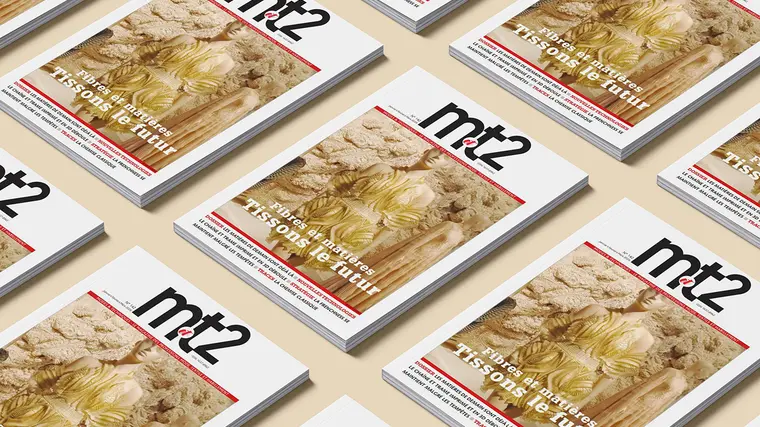
That’s the message from Arnaud Ruffin, The LYCRA Company’s vice president of brands and retail, in a new article by Isabelle Manzoni in M&T2, a French textile journal. Arnaud spoke to the publication for its Jan/Feb/March 2026 issue, diving into the details of our spandex-recycling initiatives and spelling out the future of textile circularity and spandex fiber recycling.
As Arnaud explained, the textile industry has long seen spandex as a roadblock to recycling and more sustainable fabric production. But it’s not spandex itself that’s inherently non-recyclable. We just didn’t have the right tools or processes in place to recycle it until now.
HOW SPANDEX RECYCLING WORKS
Through advances in chemical recycling pioneered by scientists at the University of Technology, Vienna, and advanced by our partner Radici InNova, tests showed that it’s possible to separate synthetic yarns in mixed-fiber garments and respin them into new, useable nylon and LYCRA® fibers.
The LYCRA Company, Radici InNova, and French lingerie leader Triumph partnered to test the possibility of closed-loop recycling with mixed-fiber fabrics. Triumph provided a fabric, made with nylon and LYCRA® fiber, and Radici InNova separated the nylon and LYCRA® fibers with its chemical recycling process. From there, Radici Group and The LYCRA Company used the recovered materials to spin new fibers, which were then knitted into a new fabric that Triumph used to create a prototype bra and underwear set.
“These collaborations illustrate a core belief,” Arnaud told M&T2. “Circularity will not be achieved by a single person or organization. A complete ecosystem is necessary, from fiber to finished product, through recycling and distribution.”

These pilot programs may be small, but they’re setting the stage for circularity. As Arnaud explained to M&T2, The LYCRA Company has a plan that involves getting the pieces in place for a fully circular system in the next five to 10 years, where garments and fabrics can be returned for recycling and turned back into usable products that meet the performance expectations of the original fibers.
Said Arnaud, “It’s this approach — combining innovative materials, durability, recyclability, and industry partnerships — that informs our vision and path for 2026 and beyond.”
Buy the latest issue of M&T2 to read more from Arnaud Ruffin’s Q&A.